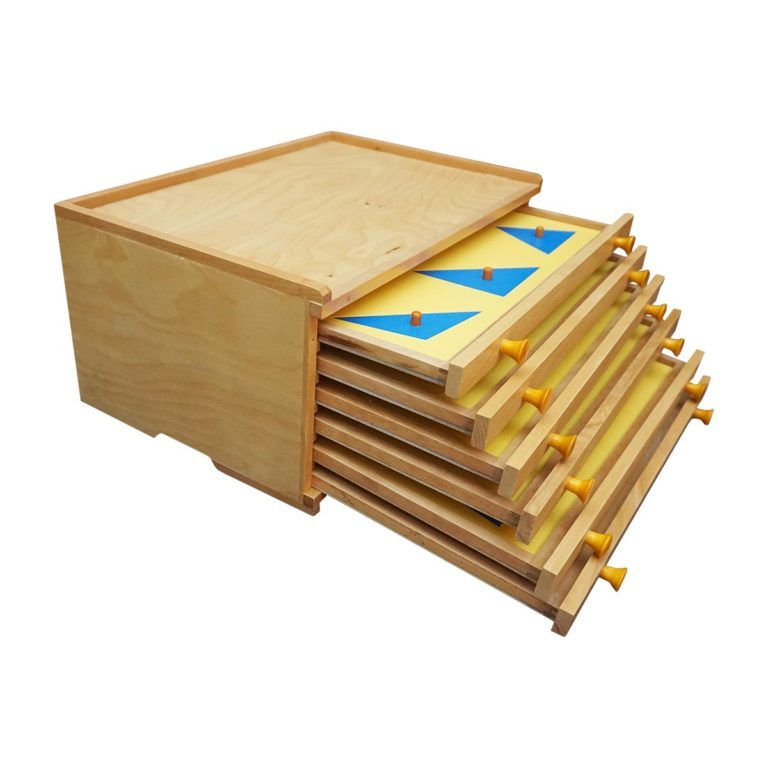
Product Description: The Sound Boxes set consists of 6 pairs of cylinders, each containing a different sound intensity. These cylinders are designed to produce different levels of sound when shaken, offering children a range of auditory experiences. The set is designed to develop a child’s ability to discriminate sounds based on their intensity (loud and soft), introducing the child to the concept of gradations in sound. Each cylinder features a red cap on one half of the pair and a blue cap on the other for easy differentiation and matching during activities. The cylinders are housed in two high-quality wooden boxes, each providing a secure and organized storage solution.
Sound Boxes
The Sound Boxes set is designed to help children develop their auditory discrimination by exploring different intensities of sound. The cylinders, when shaken, produce varying levels of sound, allowing the child to distinguish between louder and softer sounds. This material enhances the child's sense of hearing and helps build concentration, attention to detail, and muscular control in a fun and engaging way.
1. 6 Pairs of Cylinders: The set includes 6 pairs of cylinders, each pair producing different sound intensities. The cylinders are painted with a red cap and a blue cap to visually differentiate the two sets and aid in the process of matching and gradation activities. 2. Varied Sound Intensities: o The cylinders are designed to produce sounds of different volumes when shaken. Some cylinders will produce a louder sound, while others produce a softer sound, allowing the child to explore the full spectrum of sound intensity. o This provides the child with the opportunity to develop an understanding of sound in terms of loudness and softness.
3. Storage in Wooden Boxes: The Sound Boxes are housed in two high-quality wooden boxes, ensuring that the cylinders are neatly stored and protected when not in use. The wooden construction offers durability and a tactile experience for the child. 4. Visually Differentiated Caps: The red and blue caps on each pair of cylinders not only provide a visual cue to aid in matching but also reinforce the concept of gradation in sound as the child works through the different levels of loudness and softness.
1. Auditory Discrimination:
o The primary benefit of the Sound Boxes is the development of the child’s auditory discrimination skills. The child learns to differentiate between sounds of various intensities, honing their listening skills and ability to perceive differences in volume.
2. Concentration and Focus: o The activity requires the child to focus on the subtle differences in sound, promoting concentration and attention to detail. The child learns to concentrate on the task at hand and listen closely to the sounds produced by the cylinders.
3. Matching and Sorting: o The cylinders can be paired based on the intensity of sound they produce. The child learns to match louder cylinders with louder ones and softer cylinders with softer ones, which enhances their ability to sort and categorize based on auditory perception. 4. Sound Gradation: o The Sound Boxes provide an opportunity for children to understand the concept of gradation (e.g., from quiet to loud sounds). This helps them grasp the idea that sounds can vary in intensity and be placed in a sequence, which is a fundamental concept in mathematics and science. 5. Muscular Control and Coordination: o Shaking the cylinders helps children refine their muscular control and hand-eye coordination. As they hold the cylinders and shake them to listen, they strengthen the fine motor skills necessary for tasks like writing and drawing.
6. Language Development: o The child may be encouraged to describe the sounds they hear using language such as "loud", "soft", "strong" or "weeak". This enhances their vocabulary and the ability to express sensory experiences using descriptive language.
7. Preparation for Listening Tasks: o By refining their ability to distinguish between sounds of varying intensities, the child’s listening skills are improved, which is essential for following verbal instructions and developing phonemic awareness—a key precursor to reading and writing.
1. Initial Exploration: o Present the cylinders to the child and ask them to shake each one. Encourage them to focus on the sound that each cylinder makes. Ask questions like: "What does this sound like?" or "Is the sound loud or soft?"
2. Pairing and Matching:
o Once the child has explored the different sounds, encourage them to match the cylinders based on their sound intensity. They can place pairs of cylinders together based on which one’s sound louder or softer. o Use the red and blue caps to help the child differentiate between the pairs while engaging in the matching activity.
3. Gradation Exercise: o Invite the child to line up the cylinders in order from softest to loudest (or vice versa), helping them grasp the idea of gradations in sound. This promotes the child’s ability to understand sequences and helps develop early mathematical thinking.
4. Concentration Activity: o To enhance concentration, encourage the child to shake the cylinders with their eyes closed, focusing solely on the auditory experience. This activity encourages active listening and mindfulness.
5. Language and Description: o Encourage the child to describe the sounds in their own words. For example, "This cylinder makes a soft, gentle sound" or "This one makes a loud, sharp sound." This helps with language development and communication skills.
The Sound Boxes provide a simple yet effective way for children to develop their auditory discrimination and deepen their understanding of sound. By exploring sounds of different intensities, children strengthen their listening skills, focus, and concentration while also improving their fine motor control and muscular coordination. The Sound Boxes encourage children to match, sort, and grade sounds, which is a precursor to understanding the concept of gradation in other areas, such as mathematics. This material not only supports the development of sensory perception but also lays the foundation for language skills and early scientific thinking, making it an invaluable tool for both home and classroom environments. Would you like suggestions for additional activities or ways to integrate the Sound Boxes into a broader sensory exploration?