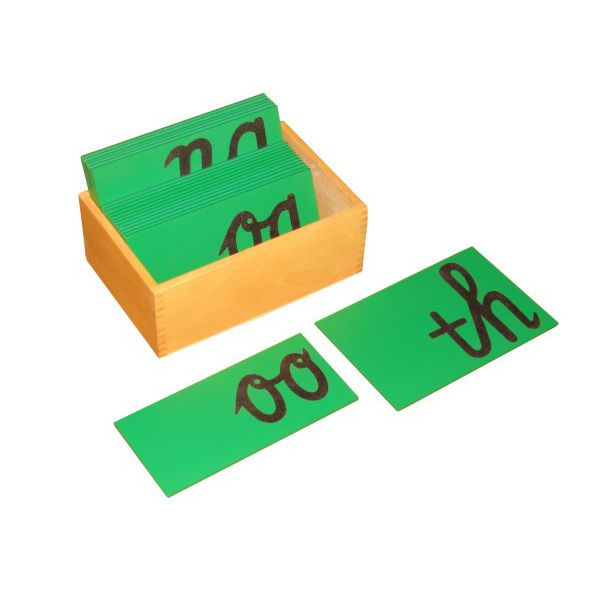
1. Cursive Writing: The phonograms are written in cursive script, which is a flowing style of handwriting where letters are connected. Learning cursive at an early age can help children
develop fine motor skills, improve writing fluency, and even promote better spelling and word recognition.
2. Phonetic Focus: The phonograms typically include common combinations of letters (such as "ch", "sh", "oo", "ng" "ee" etc.) that correspond to specific sounds in the language. This helps children not only recognize the letter shapes but also understand how these combinations function together to form words.
3. Tactile and Visual Learning: By using sandpaper letters (often in the form of cursive phonograms), children can trace these letter combinations with their fingers, which strengthens their sensory connection to the shapes and sounds. This hands-on learning
approach is particularly effective in reinforcing the concept of phonetics and writing.
4. Wooden Box Storage: Similar to other sandpaper letter sets, cursive phonogram cards may be stored in an attractive wooden box, which keeps the materials organized and easily accessible for children. This enhances the Montessori-inspired learning experience.
5. Multi-Sensory Learning: By incorporating both visual (reading), auditory (hearing the phonetic sounds), and tactile (tracing cursive letters) learning methods, children get a well- rounded approach to understanding both the sounds of the language and its written form.